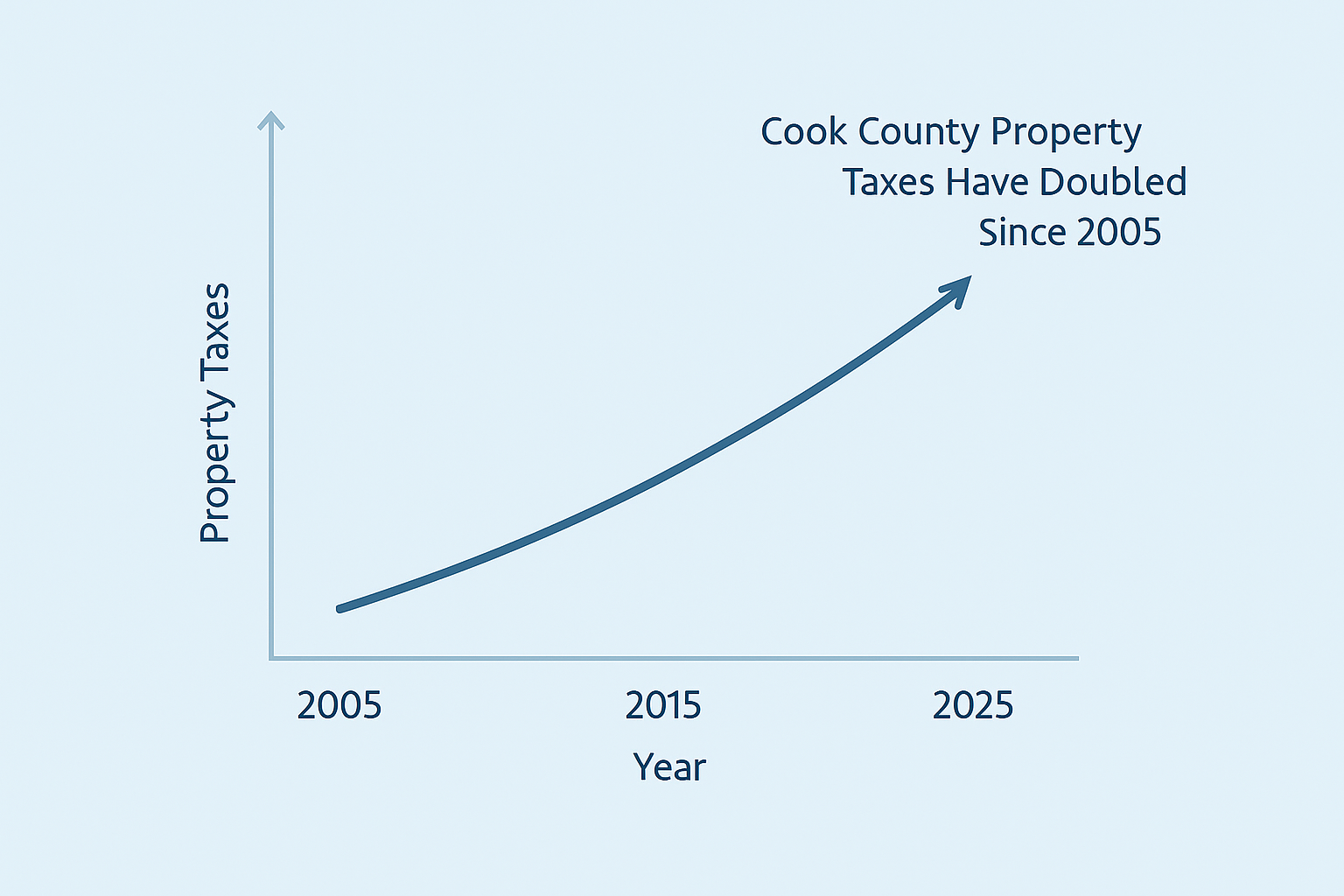
The issue of Cook County property tax has reignited public outrage as a newly released report reveals deep structural inequities, record‑high assessment appeals, and mounting calls for reform. The county is now responding with short-term relief programs even as officials debate long-term systemic changes.
Why Cook County Property Tax Is a Flashpoint Now
Cook County homeowners are under significant stress: property tax bills have spiked sharply, especially following recent reassessments, and the appeals system is under fire for favoring commercial entities. At the same time, the county is launching a $15 million relief fund to address the growing burden for low- and moderate-income residents.
These developments have converged into a broader fight over fairness, transparency, and predictability in the Cook County property tax system.
The Scale of the Problem: Unprecedented Appeals and Burden Shifts
Record Appeals Volume
For the 2024 tax year, the Cook County Board of Review received a staggering 273,907 property tax appeals, an increase of nearly 41% compared to previous years. This surge suggests mounting frustration among property owners, particularly residential homeowners, who feel their assessments are unfair or inconsistent. Chicago City Wire+1
Disparities in the Appeals System
According to a recent report from Cook County Treasurer Maria Pappas, the property tax appeals system is “broken.” Her analysis argues that business owners and wealthier homeowners are disproportionately benefiting from successful appeals, while lower‑income homeowners — particularly Black and Latino families — are seeing their bills climb. WBEZ+1
Over the 2021–2023 reassessment cycle, businesses reportedly secured more than $3.3 billion in valuation reductions. By contrast, homeowners achieved roughly $2.8 billion in reductions — while an additional $1.9 billion in tax burden shifted onto residential properties. PR Newswire+1
Tax Bill Spikes for Many Homeowners
About 240,000 Cook County homeowners have seen their property tax bills jump by 25% or more in a single year, according to data from the Assessor’s Office. For many, that’s not just a budgeting challenge — it’s a financial crisis. cookcountyassessor.com
Assessor Fritz Kaegi has publicly called for more predictability in the property tax system and has endorsed reform proposals aimed at simplifying assessments and making tax increases more transparent. cookcountyassessor.com+1
Response: Relief Fund and Reform Momentum
$15 Million Homeowner Relief Fund
In a bid to ease the immediate tax burden, Cook County has approved a $15 million Homeowner Relief Fund. The program will offer one-time $1,000 payments to eligible homeowners who have experienced a 50% or greater increase in their property tax bills during the 2021–2023 reassessment period. Cook County
To qualify, households must make at or below 100% of the Area Median Income and demonstrate the required tax increase. Applications are expected to open soon, with funds distributed shortly after. Cook County
County Board President Toni Preckwinkle said the relief fund is a stopgap solution: “This fund will provide short-term support … while my administration continues to work … to develop long-term solutions.” Cook County
Efforts to Reform the System
Key stakeholders, including the Property Tax Reform Group, are pushing broader reforms. Assessor Kaegi has endorsed several of these proposals, including:
- Greater transparency in valuation processes
- A more predictable appeals system
- Better data sharing and collaboration across taxing authorities cookcountyassessor.com+1
The Assessor’s Office also released new estimated tax rates for 2025, reflecting anticipated reassessments. Interestingly, these estimates suggest a decrease in the median tax rate, thanks to a projected growth in the tax base that outpaces levy increases. cookcountyassessor.com
Financial and Equity Risks
A Shift in the Tax Burden
Critics argue that current trends amount to a wealth transfer from homeowners to businesses. The appeals data suggests that commercial entities are more successful in lowering their assessed values, exacerbating the tax burden on residential taxpayers. WBEZ+1
Homeowners in lower‑income, predominantly minority neighborhoods are being hit the hardest, compounding existing economic inequities. Chicago Sun-Times
Structural Instability
The volatility of appeals and tax spikes undermines predictability, making it difficult for many households to plan. Without reform, more homeowners may feel compelled to appeal — but doing so requires time, documentation, and sometimes professional help.
Moreover, appeals are just a temporary fix. Without fundamental changes to assessment methods, the cycle may continue, and relief programs may fall short.
Political and Fiscal Constraints
Long-term reform will require coordination across multiple agencies: the Assessor’s Office, Board of Review, County Board, and state lawmakers. Achieving consensus on changes — such as appeal reform or valuation transparency — will not be easy, especially given political divides.
Meanwhile, the one-time relief fund is limited in scale. $15 million may help many homeowners in the short term, but it is unlikely to address the structural inequality baked into the appeals system.
What Homeowners Should Do Now
- Check Eligibility for Relief: Homeowners who saw significant tax bill increases should stay alert for the launch of the relief fund application.
- Consider Filing an Appeal: With historic appeal volume, many homeowners are challenging their assessments — but timely documentation and comparables are critical.
- Stay Engaged in Reform: Residents can support or advocate for systemic reform via local community groups or by contacting county officials.
- Budget for Volatility: With assessments and tax rates shifting, planning for higher or variable tax bills may be necessary — especially for fixed-income households.
Looking Ahead: Will Reform Stick?
There are three key indicators to watch:
- How many homeowners apply and receive relief — If demand far exceeds the $15 million fund, political pressure may grow for more permanent measures.
- Legislative momentum — Will the Property Tax Reform Group succeed in pushing through meaningful changes to the appeals and assessment process?
- Outcome of reassessments — The 2025 reassessment cycle and the tax rate estimates could provide insight into whether the system is stabilizing or perpetuating inequities.
Final Thought
The Cook County property tax crisis underscores a deeper systemic challenge: how to fairly assess and distribute the cost of local services in a way that doesn’t disproportionately burden the most vulnerable. The introduction of a relief fund is a meaningful first step, but without long-term reform, many homeowners will continue to face financial stress — and the cycle of appeals and inequality may only worsen.
Credit: bizbeatz.com
Date: November 16, 2025